
Pride in Place: Building Assets or Building Belonging?

[First posted on LinkedIn, October 23, 2025]
Over the past couple of years, the community and voluntary sector, spearheaded by the work of the Community Wealth Fund Alliance and the Independent Commission on Neighbourhoods (both catalysed by Local Trust) have been driving forward policy asks and advocating for a significant investment in a neighbourhood renewal strategy that would seek to address the deep inequalities that are being faced in communities across England.
All of us, including myself, have been eagerly awaiting the policy steer from the new Government on its commitment to those places that the previous administration has focussed on through their ‘levelling up’ ambition.
In the last month we have now seen the announcement of the Government’s Pride in Place programme. A flagship Programme committing to town-centre upgrades, regeneration of cultural venues, improved public spaces, increased access to green space and heritage restorations. This announcement is a clear and visible commitment to ‘place based regeneration’.
It’s hard to argue with the ambition. The 225 neighbourhoods identified by the OCSI research supported by Local Trust makes it clear that many neighbourhoods are lacking the social infrastructure and spaces that they need. Complementing this, research by Local Trust (with Frontier Economics ) shows that where there are significant gaps in social infrastructure in neighbourhoods there are poorer outcomes for skills, employment and health. Therefore, this investment is clearly much needed.
However, I have been left reflecting on vital question; how can a programme that seeks to build ‘pride in place’ connect with hearts and minds of people who have been left out and ‘left behind’ for far too long’.
A capital heavy starting point
Reading through the Pride in Place Mission and its performance metrics, it’s clear that the programme tilts strongly toward capital investment.
The key indicators and evaluation metrics all measure what’s been built; the number of new facilities, the square metres of renovated spaces and the number of retrofits. But pride in place doesn’t just come through bricks and mortar. Even if people have been consulted and say they want something built, pride only takes root when people feel connected, when people trust each and when people feel a sense of shared ownership and belonging around their neighbourhood.
Without the latter we risk creating ‘better’ or ‘nicer’ spacers but not stronger places. Because while assets can spark a sense of achievement, it is relationships that sustain pride. Relationships are the foundation that that anchors people to place, to each other, and to the democratic life of their community.
Engagement is there – but how deep is it?
Despite the evaluation metrics that measure solely the quantitative impact of the funding, looking across the Programme, there is a recognition of the importance of community engagement. The creation of Neighbourhood Boards shows an understanding that residents must have a say in shaping and driving forward the Pride in Place Programme at a local level.
However, the depth of that engagement is left undefined. As Sherry Arnsteins’ “Ladder of Participation” shows “Community involvement” can mean anything from a one-off consultation to a genuine process of co-creation and shared governance. Without clarity on depth, engagement risks becoming procedural and a step in the delivery plan rather than a relationship to nurture.
Those of us who work in relational community organising know how wide that gap can be: between being listened to and being actively listened with.
The evidence for ‘what works’.
Over the last 10 years there has been a wealth of literature and research published that shows the importance of ensuring people at a local level can take the lead in bring about change. Research from the Bennett Institute for Public Policy and the What Works Centre for Wellbeing shows that belonging, cohesion, and pride rise most where people have opportunities to act together; to deliberate, decide, and deliver.
This idea, what is sometimes acknowledged as ‘collective efficacy’ argues that local people, when supported can be the key actors in driving forward change.
Therefore, it is crucial that whilst the physical assets that exist in places can serve as the foundation for local people to come together, it is, as Eric Klinenberg argues in his work Palaces for the People, that trust, relationships and shared purpose which turns those assets into something that brings life into a place.
Assembly culture: from consultation to co-creation to potential co-governance
The Pride in Place programme could be a once in a generation opportunity to catalyse genuine Pride in Place. But this must come through acknowledging and recognising the importance that the focus on capital investment must be matched with deep, relational engagement work that can animate belonging, connection and conversation.
Over the last 10 years there have been number of organisations working towards developing grassroots and ‘bottom up’ approaches to build more deliberative, participatory, democratic neighbourhood structures as a response to tackling some of the biggest social challenges we are facing.
The Centre for Climate Change and Social Transformation, Iswe and others all have centred participatory approaches to generating solutions around climate change. Organisations such as Community Organisers in the UK has been supporting the growth and development of Humanity Project to seed and embed ‘neighbourhood popular assemblies’ to grow the practice and art of convening people to come together and talk about what matters, bridge divides, and take shared action.
In this work, these public and popular assemblies aren’t public meetings or consultations. They’re spaces for relationship-building and power-sharing. A space where people move from individual concerns to collective purpose.
This work is putting in place the ‘listening infrastructure’ that is as important as bricks and mortar. Through training and support it is embedding in local organisations and associations the tools and training to convene assemblies, build networks across neighbourhoods, and embed a culture of shared reflection and action.
The expertise developed within the “participation sector” in building social capital, strengthening collective efficacy, and enabling local decision making through citizen deliberation and public participation could help the Pride in Place programme bring an ‘Assembly Culture’ to life by enabling:
- Neighbourhood Boards to serve as listening platforms, not just committees.
- Community hubs to be a space for ongoing dialogue, not one-off events.
- Organisers and facilitators to work alongside architects and contractors — to build trust, weave networks, and keep participation alive long after the ribbon-cutting.
Building pride through the art of assembly
As shared, the challenge isn’t just the about the straightforward debate of ‘assets vs organising’. It is about developing an effective balance. One that recognises the important that deep relational engagement has on developing agency and creating ‘ownership’ alongside the need for capital investments in ‘assets’ that can create visible improvements.
This would not only change the way places look, but importantly how people live together.
This balance could be achieved through three very practical steps that could be enacted through Government or through Programme development at a local level.
- Define depth — Set clear expectations for meaningful engagement, from listening to shared decision-making.
- Fund social infrastructure — Resource organisers, facilitators and assembly convenors as a core delivery cost, not an optional extra.
- Measure belonging — Track trust, participation and connectedness alongside satisfaction and spend.
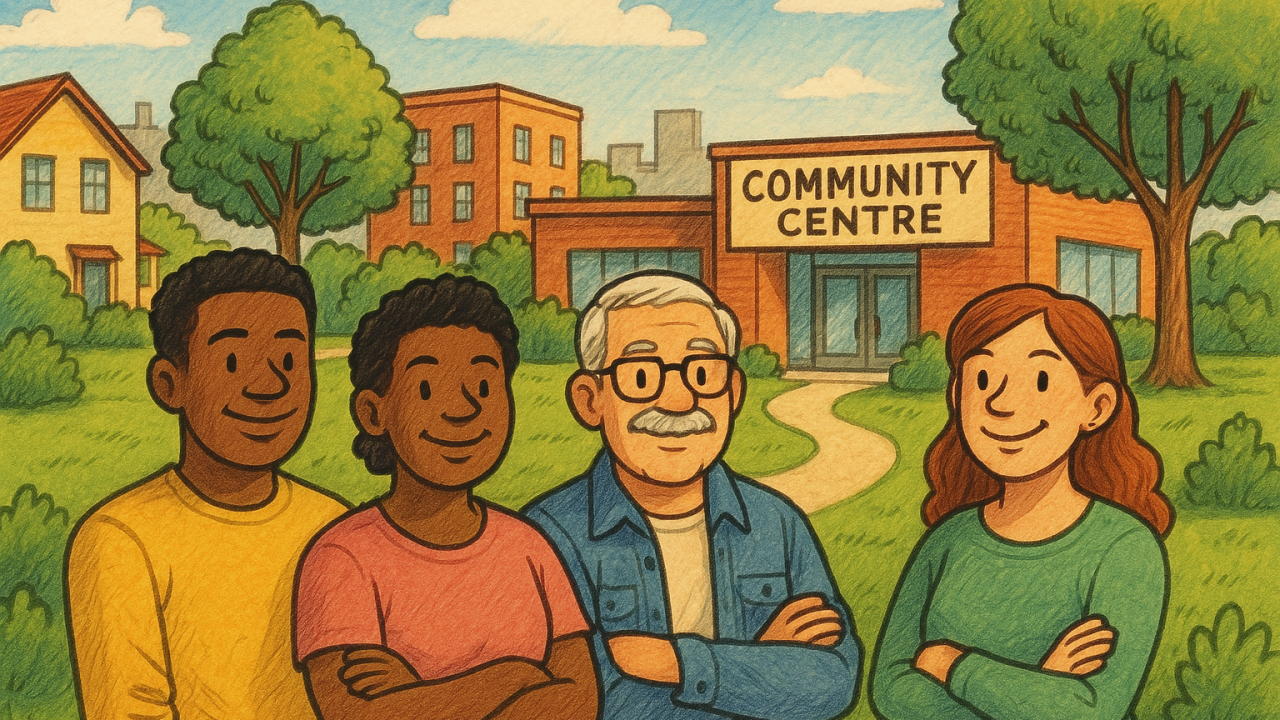
Pride isn’t built when we open a new community centre or children’s play area. It’s built when people fill that place with connection, conversation and collective purpose.
We must pair investment with involvement, and embed assembly culture alongside asset development. In doing this, Pride in Place could become more than a regeneration scheme — it could be a quiet revolution in how we experience democracy at neighbourhood level.
References & Further Reading
Pride, Place & Levelling Up
- Bennett Institute for Public Policy (2022) – Pride in Place: Tackling the crisis of belonging through civic renewal: https://www.bennettinstitute.cam.ac.uk/publications/pride-in-place/
- Bennett Institute (2023) – Townscapes: Pride in Place.
- Department for Levelling Up, Housing & Communities (2024) – Pride in Place Mission Narrative: https://assets.publishing.service.gov.uk/media/65b2348bf2718c0014fb1d29/Narrative_for_Pride_in_Place.pdf
- Local Trust (2023) – Social Infrastructure: The Foundation for Shared Prosperity. https://localtrust.org.uk
Social Capital, Belonging & Collective Efficacy
- Sampson, R. (2012) Great American City: Chicago and the Enduring Neighborhood Effect.
- Putnam, R. D. (2000) Bowling Alone: The Collapse and Revival of American Community.
- What Works Centre for Wellbeing (2018–2022) – Community Wellbeing Evidence Reviews. https://whatworkswellbeing.org
- Klinenberg, E. (2018) Palaces for the People: How Social Infrastructure Can Help Fight Inequality, Polarization, and the Decline of Civic Life.
Relational Democracy & Community Power
- New Local (2023) – Community Power: The Evidence.
- Power to Change (2022) – Community Business Market Report.
- The Relationships Project (2022) – The Relational Handbook.
- IPPR (2023) – Turnout Inequality in the UK.